

The two problems that most tactical athletes/busy individuals have:
Managing training load.
Unpredictable schedule that interferes with consistency and progression.
I didn’t learn that just from coaching. I learned that from being that EXACT guy in the military who would often choose short term intensity or couldn’t finish a program from start to end without something getting in the way.
We tend to think that harder is better and that if you’re not seeing stars at the end of your workout then you messed something up.
Maybe part of what drives this desire for intensity (outside of the Type A personalities) is the lack of consistency that often comes from having an unpredictable schedule.
Since many of my peers, and perhaps you, haven’t been able to get through an 8-12 week program without travel or time in the field getting in the way, then we just aim to do the hardest thing possible in the gym to maximize the time we have.
The BOA System, implemented on the Warfighter training team, solves this problem.
BOA stands for Build, Output, and Armor, and are the three categories that each day on Warfighter falls under.
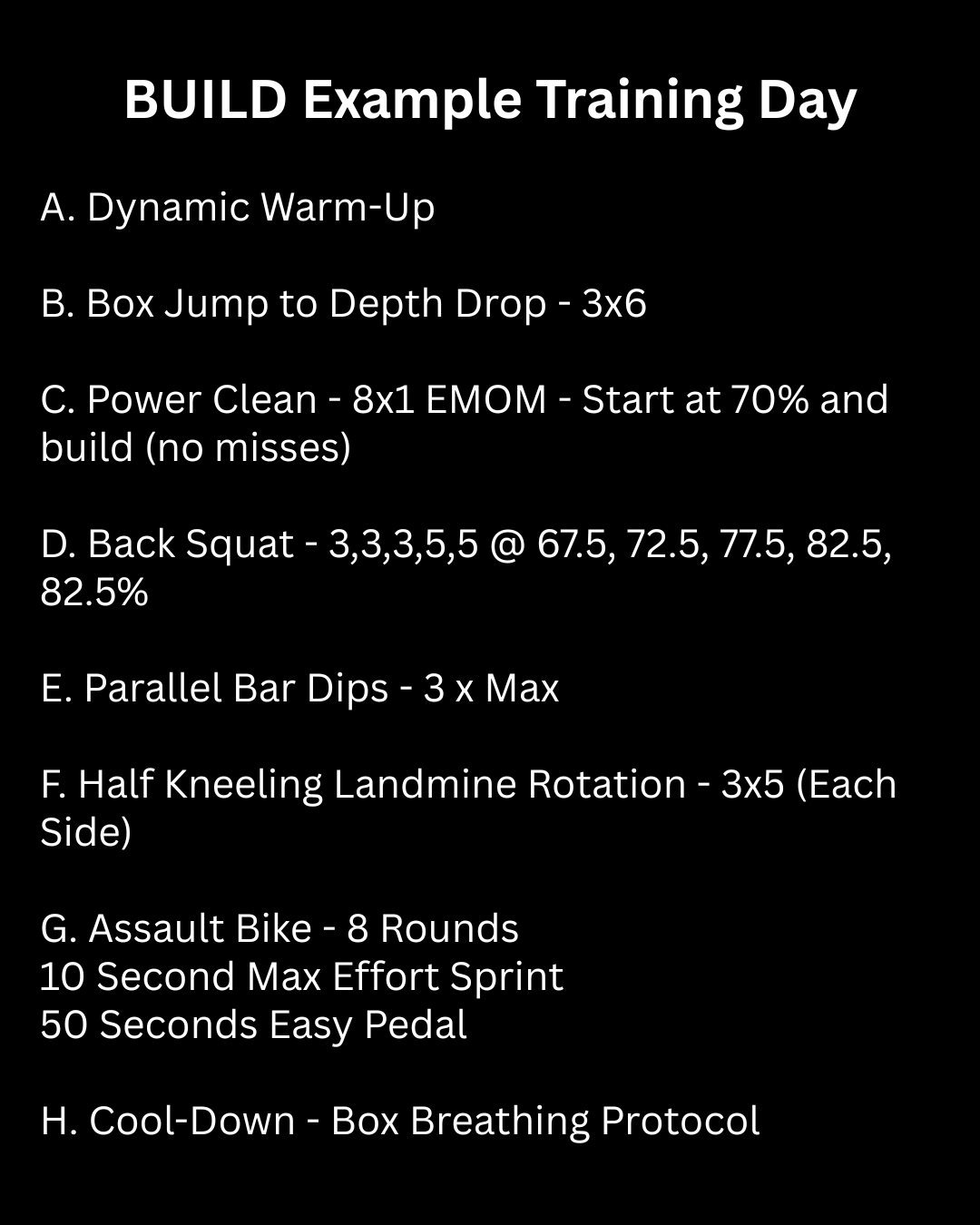
BUILD days include heavy total and lower body movements, such as cleans, squats, deadlifts, and all of their variations. These movements are the foundation and main focus of the training session.
Accessory work on build days can be either upper or lower body to provide a total body training session. Build days conclude with low impact, but moderate to high intensity conditioning. Examples include repeat power intervals on the Assault Bike or rower, tabata intervals, EMOMs, or any short duration conditioning falling in the 8-12 minute range.
Build days result in moderate fatigue.
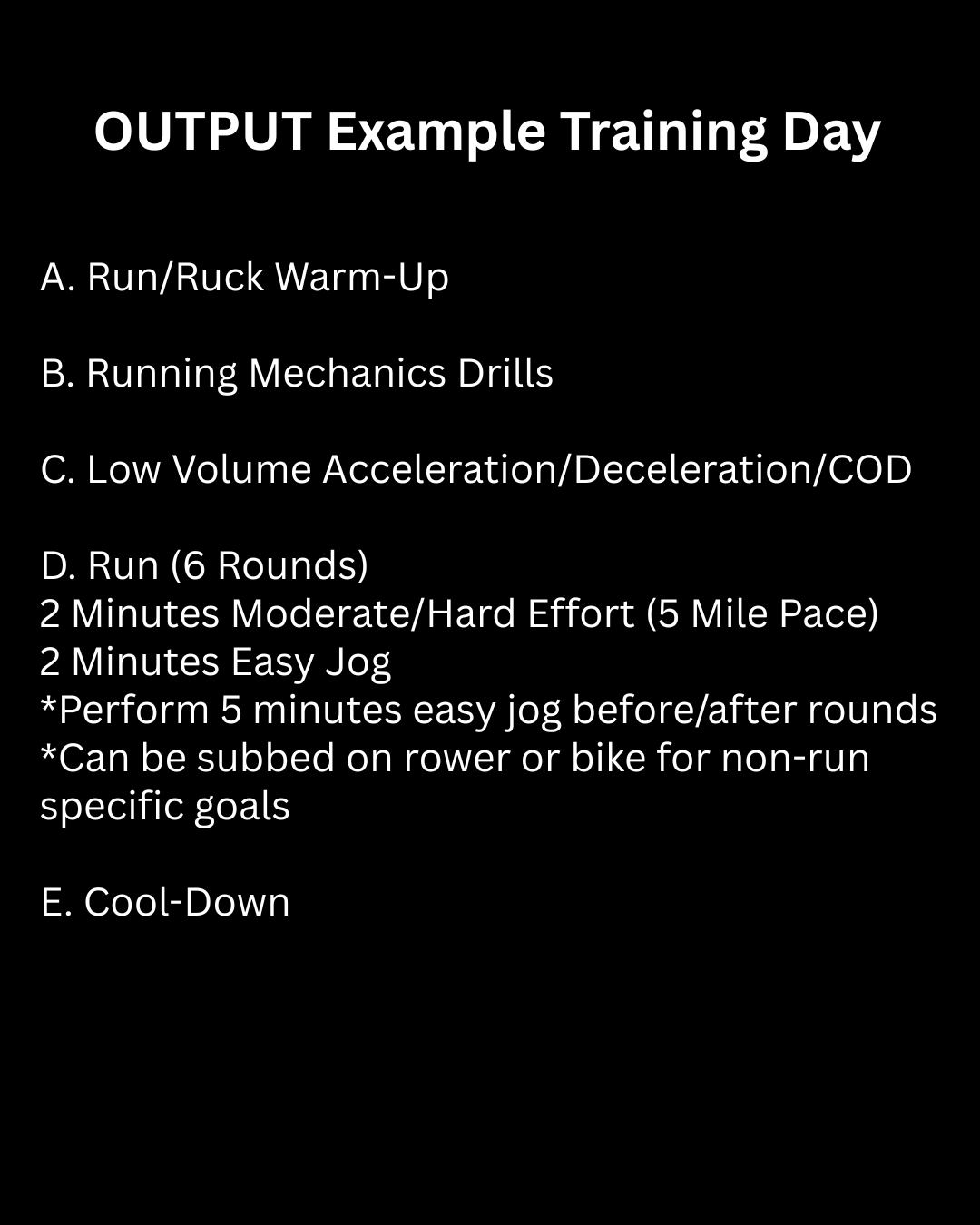
OUTPUT days are high aerobic output days. These include our higher intensity aerobic efforts (think intervals, hard fartleks, rucks for time, etc).
Output days are performed at moderate to high intensities where improving speed on mid-distance runs is the primary focus of the training day.
On Warfighter, improvement of the 2 and 5 mile runs, along with rucks lasting 6+ miles are the primary aerobic goals.
These days result in high fatigue.
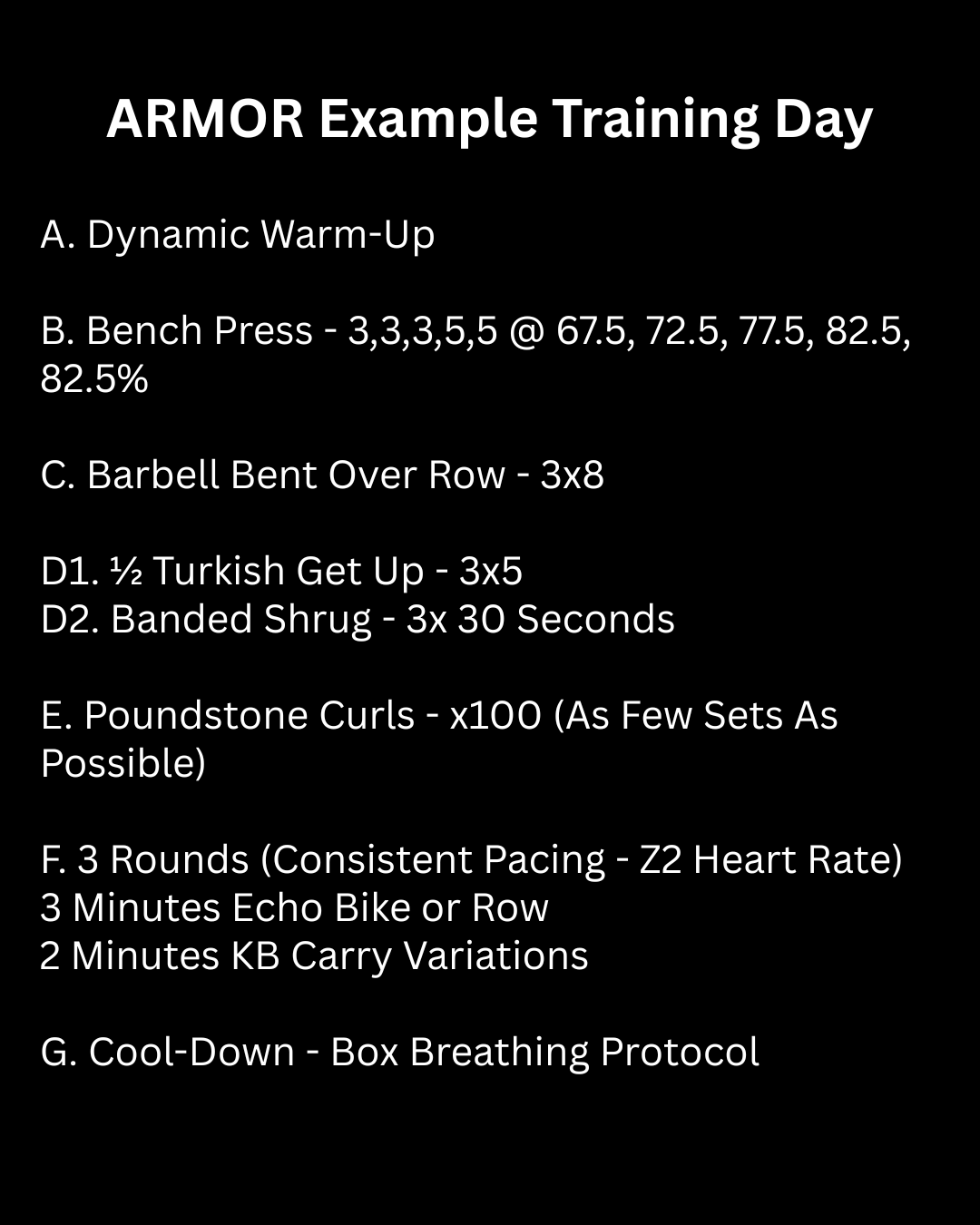
ARMOR days focus primarily on developing upper body strength and hypertrophy, along with low intensity GPP conditioning.
The bench press and overhead press are the foundational movements on Armor days and are paired with both horizontal and vertical rows. Conditioning on this day is performed in the lower heart rate zones with minimal CNS fatigue. We often expose athletes to a variety of movement and implements during GPP conditioning, with a focus on building capacity to maintain near perfect posture, positioning, and bracing for extended durations.
Armor days result in low fatigue.
Built, Output, and Armor (BOA) days are designed to be performed in this order because it gradually builds fatigue while strategically integrating a recovery day mid-week. This allows the athlete to “peak” fatigue in two waves throughout the training week while sufficiently recovering and adapting from training.
Quick Note: The Armor “Recovery Day” doesn’t mean we aren’t training hard. It means we are choosing movements that will not produce a significant amount of fatigue that will affect the following training day.
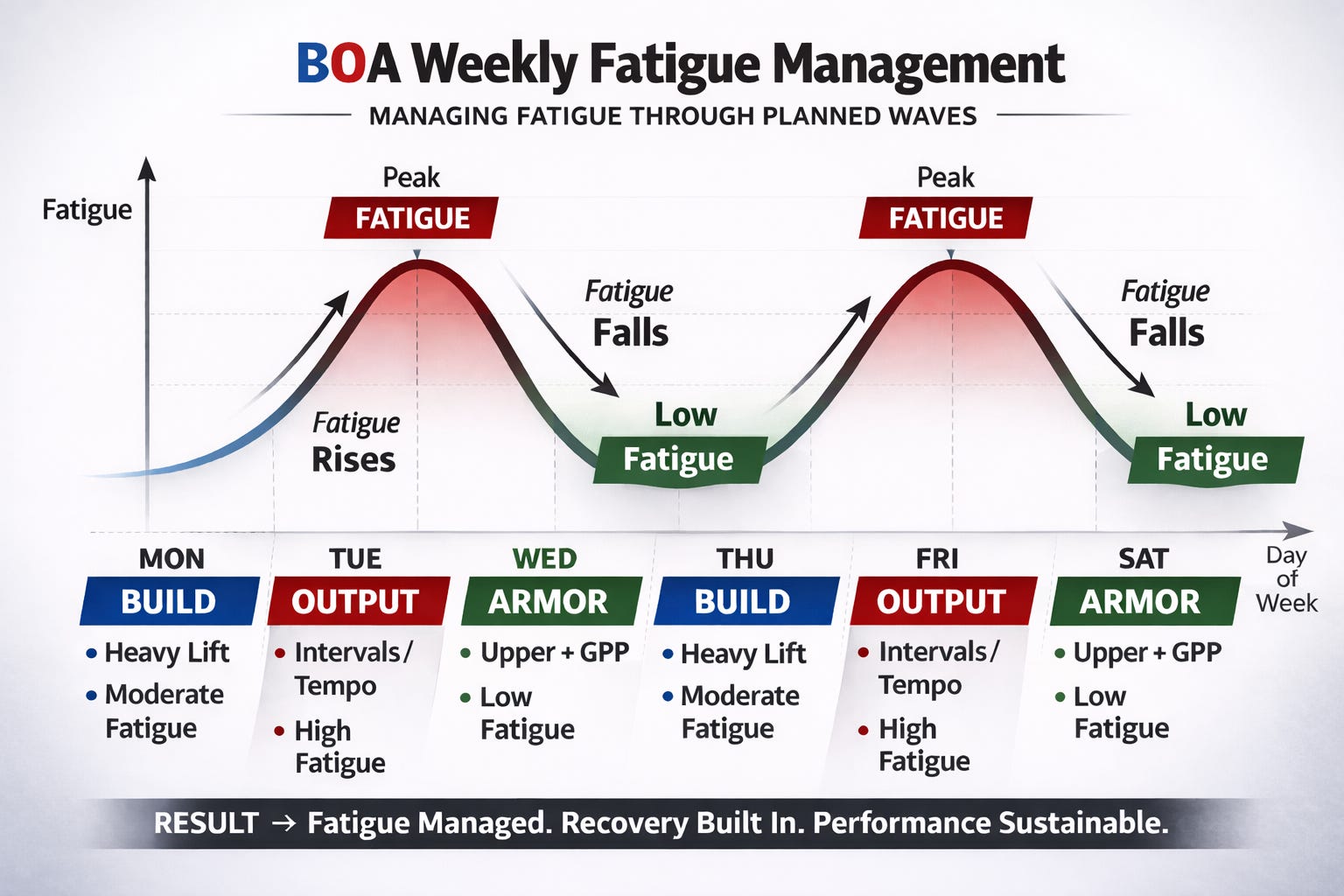
Because we are intentional about fatigue management, we are able to increase the frequency of conditioning and conduct four strength training sessions per week.
Most people trying to lift 4-5 days a week while conditioning every day just dig themselves into a recovery hole.
This is how you do it intelligently, with intent, and actually recover and make gains.
Now, you may ask:
“What if I don’t have 6 days a week to train? Can I still do this?”
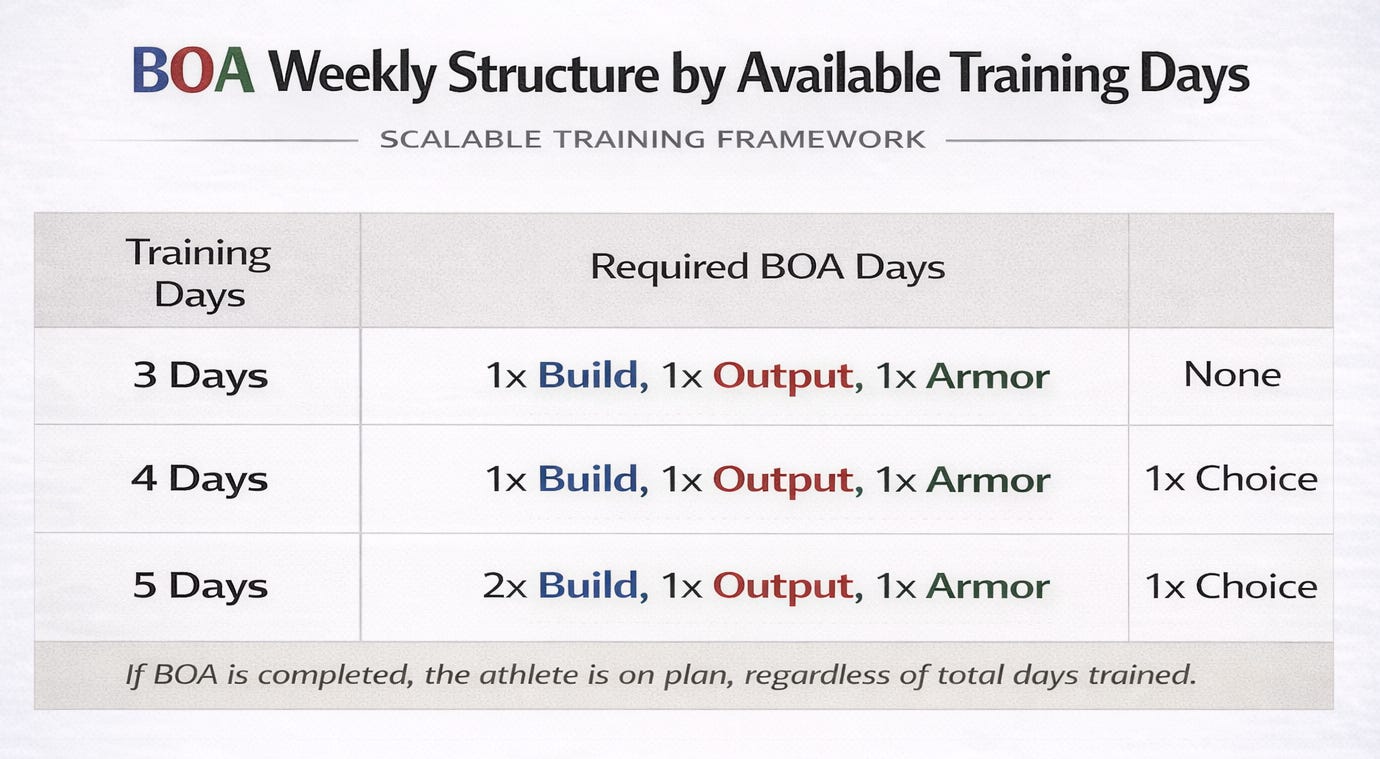
What makes this system different from standard fatigue management is that it’s scalable to 3, 4, and 5 day training weeks.
The full BOA System is 6 days per week but can be executed with only 3 training days per week.
If you have 3 training days per week:
Pick 1x Build day, 1x Output day, and 1x Armor day. This is a complete training week. You have built total body strength and conditioned every energy system.
This is ideal for athletes who like to include BJJ training days, are conducting occupational field work, or just have a generally busy week.
If you have 4 training days per week:
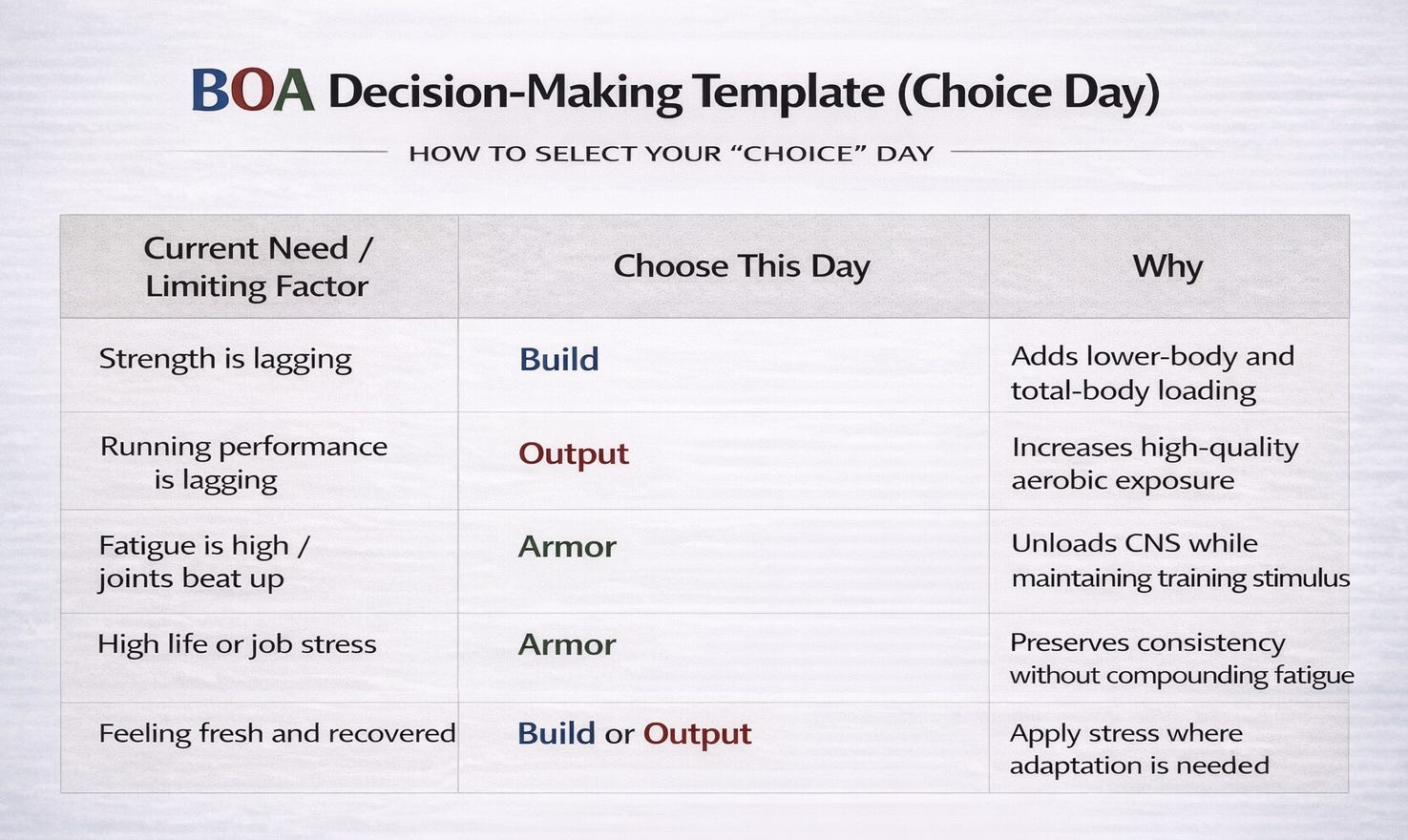
Pick 1x Build day, 1x Output day, 1x Armor day, and 1x Choice.
If total body strength is your main goal then choose Build.
If running performance is primary, pick Output.
If you are feeling beat up, fatigued, or even if you’re just feeling like an upper body pump, choose Armor.
If you have 5 training days per week:
Pick 2x Build, 1x Output, 1x Armor, and 1x Choice.
Use the same decision-making template described in the 4 day per week option.
Most autoregulation is done within a specific training day and requires RPE or HRV measurements and requires the coach to adjust the training session.
BOA autoregulates the training week and empowers the athlete to individualize in accordance with their goal. The decision-making template reduces any confusion and provides a clear pathway to selecting the correct training day.
Athletes aren’t left to their own judgement - they’re provided a clear system to individualize to their specific needs.
Most importantly, this provides max flexibility week to week. Collegiate and professional athletes don’t require this level of flexibility. Rigid programming is great when you can predict with reasonable certainty what your next week looks like.
The tactical professions, shift workers, and anyone with a high stress/fatigue/busy schedule lifestyle may require week to week flexibility.
Perhaps one week they can complete the full 6 day a week schedule, but the following week they are traveling and can only get 3 sessions in.
BOA ensures that their progress stays on track and that they are hitting the required number of exposures each week to elicit the adaptations we seek to drive through training.
There is one non-negotiable though…
1x Build, 1x Output, 1x Armor is the minimum required training week - and it is performed in that order.
Not 2x Armor, 1x Build, or any other variation.
This is a system for athletes with strength, endurance, and occupational performance goals. Missing one of the foundational days of the training week results in training gaps and does not meet the coaching intent.
Most training systems assume you can accomplish every single session.
We assume that you will experience schedule variance and training fatigue somewhere along the way.
Instead of forcing you to stack stress that results in overtraining and falling off the program, we want you to have a system for managing it effectively.
The #1 killer of the results you want is a lack of consistency.
We don’t need you to be perfect - we need you to be consistent. And this provides you a framework for staying the course.
When you hit Build, Output, and Armor in a week - you’re still on the plan. Sure, aim for all 6 days - that’s ideal - but let’s be realistic about working with the tactical population. Instead of just saying “work harder,” let’s work smarter and use a system that maximizes the efficiency of training.
KEY TO REMEMBER: BOA is not a program. It is a system for managing fatigue in a training week and autoregulating training days available. It is still up to the coach to write the sets and reps, progress volume and intensity, etc.
This is the framework for organizing the training week on the Warfighter training team.
Let’s replace guesswork with structure.
Train hard. Train with intent. Train with a system.
12 weeks after following BOA, I am really pleased with the arrangement. All attributes get a proper dose spread throughout the micro-cycle and the execution is easy to stack week after week. Good sustainable training. Nothing flashy needed.
Where can I find this program in particular? I believe the warfighter program on train heroic is the tier based system or do you have a BOA option on Train Heroic?